
About Chat & Smoke
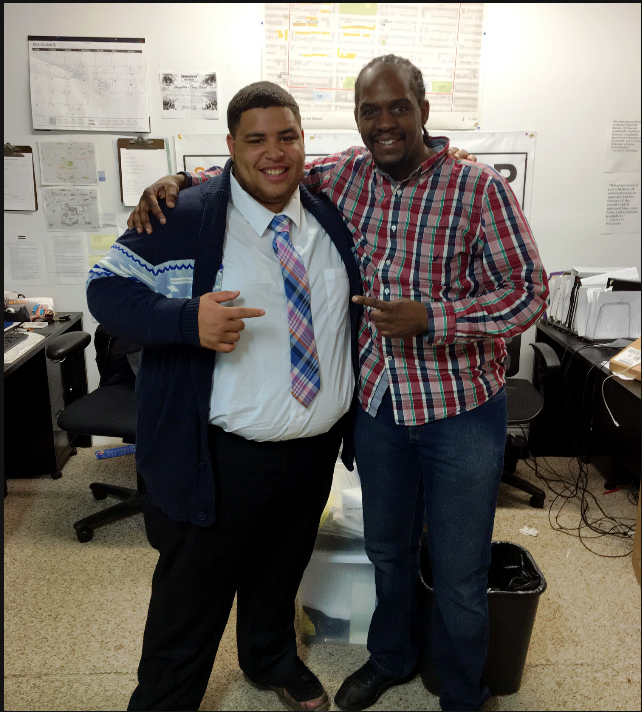
"I Know the Power of Words — Because I've Seen Them Destroy"
Growing up in East Harlem, I witnessed something that would define my life’s work:
how a tone of voice, a perceived slight, a word spoken in anger—could cost someone
their freedom. Or their life.
I watched friends get sentenced to prison over communication that escalated in seconds.
I saw young people lose their lives on the streets because a conversation turned violent.
I watched talented, brilliant Black men and women get trapped in a cycle of violence
because NO ONE taught them how to communicate with POWER instead of rage.
That’s when I realized something: People are losing their lives to poor communication skills. Who is going to teach them?
So I decided: I would learn. I would master it. And I would teach it.
In 2013 I started working with Cease Fire out of Chicago today it is called Cure Violence. I’ve worked with thousands of young people and adults in NYC schools,
NYCHA developments, undeserved and High risk communities through NYC including youth and adult secured facilities. I’ve seen lives TRANSFORMED
by one simple shift: learning to speak without Offensive, listen without defensiveness,
and preserve the opponent’s dignity.
The results? Students who changed schools entirely. Young people who avoided incarceration.
Adults who rebuilt broken relationships. Communities that chose peace over violence.
This isn’t theory to me. This is lived experience. This is professional expertise.
This is RESPONSIBILITY. I have the ability to respond to your needs professionally and dignity.
Today, the same problem is happening with younger and younger people. The consequences
are too high. The stakes are too real. I cannot stay silent.
This is why I do this work.
NYC Department of Education
"3+ years teaching communication and conflict resolution" to students, teachers, and administrators
"NYCHA Housing Developments"
"Harlem, Bronx, Brooklyn, Queens & Staten Island communities" — bringing prevention programs directly to residents
"Youth & Adult Facilities"
"Horizon Youth detention, Rikers Island facilities, department of Probation. teaching people how to break cycles of violence
The common thread in all my work? Young people and adults who’ve been told they’re threats.
Who’ve been labeled as problems. Who’ve been written off.
I go where they are. I teach them how to change their narrative.
Not by making excuses. Not by avoiding accountability. But by teaching them the REAL POWER
of dignified communication—the kind that opens doors instead of closing them, that creates
allies instead of enemies, that transforms conflict into connection.
This work happens in the places nobody else wants to go. In the schools struggling with
discipline. In the housing developments fighting violence. In the facilities where society
has given up.
But I haven’t.
The Problem: Violence Masquerading as Communication
Black youth are overrepresented in the criminal justice system.
Not because they’re “bad kids.”
But because they’re never taught effective communication.
The education system labels them as threats instead of students with potential.
They don’t have mentors showing them a different way.
One miscommunication. One escalated argument. One “disrespectful” tone.
That’s all it takes. Suspended. Arrested. Or worse.
The consequence? Lives destroyed. Families traumatized. Communities fragmented.
Potential lost forever.
This doesn’t have to happen.
My Passion: Teaching the Way That Works
Communication is LEARNABLE.
Dignity is TEACHABLE.
And when people learn it, EVERYTHING changes.
That’s what drove me to study five extraordinary leaders:
– Sister Alma Vessells John
– Alice Kornegay
– Robert “Bob” McCullough
– Dr. Jawanza Kunjufu
– Dr. Cecil “Chip” Murray
These weren’t just great leaders—they were TEACHERS of a philosophy that WORKS.
And I spent years mastering it so I could pass it forward.
Not as theory. But as a lived, tested, proven CODE.
A code that changes lives.
Built on the Shoulders of Giants — A 30-Year Lineage
🌱 THE SOIL: Sister Alma Vessells John (1906-1986)
The Connection: April 20th I was born at Harlem Hospital, where Sister Alma was once a nurse and a radical union organizer she planted a seed that would grow for generations.
Her credo became the foundation of everything:
“If You Know, TEACH. If You Don’t, LEARN.
Each One REACH One. Each One TEACH One.”
This wasn’t just words on a page. It was a WAY OF BEING.
Sister Alma Vessells John is characterized in the sources as a **”broadcasting pioneer”** and a “social healer” who transformed the roles of nursing and media into powerful vehicles for **civic empowerment and youth development**. Her life’s work was anchored by the personal credo, **”Each one reach one. Each one teach one,”** which served as a pedagogical mandate to translate professional excellence into collective community strength.
### Civic Empowerment through Institutional Reform and Media
John’s approach to civic empowerment was both institutional and subversive, moving from the hospital ward to the White House and the radio studio.
**Labor Radicalism and Desegregation:** After being fired from Harlem Hospital for attempting to unionize workers, John’s activism shifted toward systemic reform. As the final executive director of the **National Association of Colored Graduate Nurses (NACGN)**, she shepherded the organization through its merger with the American Nurses Association, achieving a landmark victory for the **desegregation of national professional organizations**.
* **Political Diplomacy:** In 1950, as a delegate for the NAACP, she met with **President Harry S. Truman** to advocate for a federal anti-lynching law and the abolition of the poll tax, demonstrating that her advocacy encompassed the fundamental rights of Black citizenship.
* **Broadcasting as Subversive Education:** For 25 years at WWRL, John used her flagship program, ***The Homemaker’s Club***, to mix domestic advice with “subversive education” on civil rights and public health. She functioned as a vital node for the **Southern civil rights movement**, broadcasting Dr. Martin Luther King Jr.’s sermons and serving as a conduit for listener donations to support the **Montgomery bus boycott**.
### Youth Development through Mentorship and Agency
John’s philosophy of youth development focused on providing young people with tangible professional skills and a sense of cultural pride to counter negative societal narratives.
* **The “Workshop on the Air”:** On programs like ***What’s Right with Teenagers***, John pioneered a hands-on pedagogical approach. Instead of merely talking to youth, she taught them to **write scripts, conduct interviews, and operate recording technology**, allowing them to produce their own content.
* **Recognition of Excellence:** In 1957, she became the **first Black woman to receive the McCall’s Golden Mike Award**, specifically for using media as a tool for vocational training and character development among Harlem youth.
* **Self-Esteem through Culture:** John utilized her platform to instill an Afro-centric identity, telling children that as descendants of those who built the **pyramids**, they “can do anything” if they want it badly enough. This aligns with the “village mentality” seen in the sources, which emphasizes that only the community can develop its children into responsible adults.
### The Alma John Workshop and the “Revolution of Love”
In her later years, John formalized her commitment to communal care through the **Alma John Workshop, Inc. (1979)**.
* **Intergenerational Connection:** These workshops created a space where **children, teenagers, and seniors** could collaborate on service projects and creative works, reviving the “extended family idea”.
* **Reaching the Vulnerable:** John extended her mentorship into **prisons, detention centers, and children’s homes**, driven by the belief that the most vulnerable were in the greatest need of the “Each One Teach One” principle.
* **A Final Mandate:** She summarized her lifelong mission as a **”Revolution of Love,”** maintaining that there was nothing wrong with the community that “more love, more understanding and more opportunity wouldn’t help”.
She was the first Black woman director of a nursing school in New York State.
She organized nurses for better conditions. She pioneered radio programs teaching
health and dignity to Black communities. She moved through a segregated system and
opened DOORS.
But what shaped me most was her PHILOSOPHY: Everyone has something to teach.
Everyone has something to learn. The job of a leader is to create spaces where
both can happen.
That became MY job too.
💧 THE WATER: Alice Kornegay & Robert "Bob" McCullough
Living in the same East Harlem community where I was raised, they SHOWED me that
“Each One Teach One” wasn’t just a slogan—it was ACTION.
* **Self-Determination in Harlem:** Alice W. Kornegay and the **Community Association of the East Harlem Triangle (CAEHT)** were pioneers in this regard, becoming the first indigenous group awarded a contract by New York City to develop its own renewal plan. This effort was born from a successful 1961 struggle to preserve the “residential flavor” of the neighborhood against city attempts to convert it into a commercial strip.
Alice Kornegay resisted when the city tried to commercialize our neighborhood.
She built schools. She created senior centers. She developed housing. She organized
her community to TAKE CONTROL of their own future.
* **Physical Infrastructure:** Under the CAEHT’s sponsorship, hundreds of housing units were built, including the **Triangle Apartments, Jackie Robinson House, and AK Houses**
During his time in college, Robert “Bob” McCullough established himself as an elite athlete and a historical figure at **Benedict College**, an HBCU in Columbia, South Carolina. His collegiate basketball career was characterized by prolific scoring and record-breaking performances:
McCullough was a scoring Machine averaging an exceptional **36.4 points per game**. This performance made him the **second-highest scorer in the nation**
**Breaking Barriers:** In 1965, McCullough made history by **breaking the color barrier** in the Palmetto State when he became the first African American to play in the Greenville Southern Textile League post-season tournament, where he was also named to the all-tournament first team.
Following his standout college career, McCullough was drafted by the **Cincinnati Royals** of the NBA in 1965 and was offered a contract by the Harlem Globetrotters. His legacy at the college is commemorated by his induction into the **Benedict College Athletic Hall of Fame**, both as an individual in 2004 and as part of the 1964 team in 1987. His academic journey continued well after his undergraduate years, as he eventually earned a Master of Science from Lehman College and pursued further studies at New York University, Cornell University, and Hunter College.
He spent 50+ years running the Rucker Tournament and his “Each One Teach One”
youth program—proving that sports could be a vehicle for mentorship and transformation.
Together, they taught me: THEORY WITHOUT EXECUTION IS JUST TALK.
You have to show up. You have to do the work. You have to stay in the community.
You have to produce RESULTS.
This taught me RESILIENCE.
📚 THE NUTRIENTS: Dr. Jawanza Kunjufu (Age 16 - Life Changing)
At 16 years old, I read his book: “Countering the Conspiracy to Destroy Black Boys.”
This book changed how ADULTS saw MYSELF and other young blacks youth.
Not as a “social threat.” But as a “student with POTENTIAL.”
Dr. Kunjufu exposed the systems designed to harm Black boys:
– Teachers who see assertiveness as aggression
– A “fourth-grade failure syndrome” where curiosity dies
– Special education pipelines that trap students
– Peer pressure that makes excellence look like “acting white”
He didn’t just critique the system. He provided SOLUTIONS:
– Culturally responsive teaching
– Single-gender learning environments
– Rites of passage programs
– Redefining what masculinity means
Most importantly, he showed me that understanding SYSTEMS was as important
as personal transformation.
You can’t change alone. You have to understand—and challenge—the structures
trying to limit you.
This taught me CRITICAL THINKING and SYSTEMIC AWARENESS.
☀️ THE SUN: Dr. Cecil "Chip" Murray (3 Years of Study)
Dr. Murray became the light that grew everything else.
His communication philosophy shaped how I think about influence:
✓ Speak WITHOUT being offensive
✓ Listen WITHOUT being defensive
✓ Always preserve the DIGNITY of your opponent
I studied his work for three years. Watched how he led Los Angeles through uprising
without destroying the door to tomorrow. How he spoke truth to power while keeping
powerful people at the table. How he built movements based on RESPECT.
When his church became an 18,000-member megachurch, he didn’t isolate from the
struggle. He opened the doors. He brought in gang members AND corporate leaders.
He created space for BOTH to be heard and honored.
That’s when I realized: The way you WIN isn’t by destroying.
It’s by INVITING.
It’s by showing people they have a place at the table. That their humanity matters.
That change is possible if we do it TOGETHER.
This taught me LEADERSHIP and the POWER OF DIGNITY.
🌟 THE FRUIT: My Anti-Violence Communication Code
Everything I learned from these five giants, I synthesized into something clear,
teachable, and replicable.
Not because I invented it. But because I honored the lineage, learned deeply,
and committed to passing it forward.
MY ANTI-VIOLENCE COMMUNICATION CODE:
✓ Each One, Teach One methodology (Sister Alma)
✓ Speak without being offensive (Dr. Murray)
✓ Listen without being defensive (Dr. Murray)
✓ Always allow your opponent to leave with their dignity (Dr. Murray)
✓ Resilience through adversity (Bob McCullough)
✓ Exposing systems of harm (Dr. Kunjufu)
✓ Community-based solutions (Alice Kornegay)
✓ Mental health awareness and safe spaces (All of them)
This Code works because it’s not theoretical—it’s TESTED by people who lived it.
And now, I teach it to YOU.
2013 Violence interrupter outreach worker
1000+ people who I directly helped
Young People Trained
89%
Improved Conflict Resolution
3 years at Gotham high School
Schools Teaching Our Methods
Founding Member of 2 NYC cure violence sites
Years of Transformation
The Results Speak for Themselves
"My son went from getting suspended every month to becoming a peer mediator. The communication skills he learned didn't just change his behavior—they changed his future."
— Parent of Changed Student
"I used to solve problems with my fists. Now I solve them with my words. This program showed me that being heard doesn't require being loud—it requires being clear."
— Former At-Risk Youth
"In 13 years of education, I've never seen a program create this level of lasting change. Students don't just learn conflict resolution—they internalize dignity and respect."
— School Administrator